
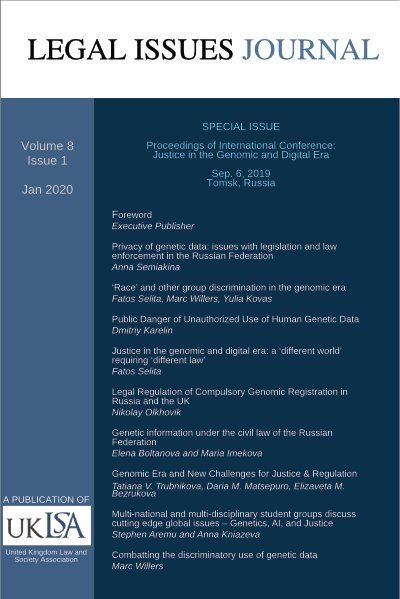
January-June 2020
ISSN 2516-1210 (Print), 2515-9887 (Online)
Discoveries in the last two decades have created a ‘different world’, which requires ‘different’ laws. They have created a world where: enormous information on people’s past, present and future can be extracted from DNA alone; the DNA of millions of people has already been sequenced; the cost of sequencing is around 30 million times less than in 2003; additional detailed personal information is collected from numerous sources, such as mobile phones, hospitals, bank cards; this information is shared internationally among numerous powerful private and State organisations; and use of this information can be highly profitable for these organisations. Under these conditions, current law is unable to fully protect rights such as that of data protection, privacy, a fair trial, and non-discrimination on genetics and other basis – rights valued by societies. For the law to serve its key purpose, it now must adapt (evolve) to this fast and fundamental change in the ‘environment’. In relation to protection from data misuses, as privacy (genetic and other) is not possible, laws are required which can minimise negative impact of data misuses. Key stakeholders (e.g. judges, policymakers) would need to understand how genes work and how genetic information is used in order to appreciate the urgency of updating laws and to build effective protection.
genetic privacy, genetic discrimination, digital era, genomic laws, genetic data protection, genetic risks, genetics and justice.
Justice systems in advanced economies, such as the UK, EU, US, and Canada, pride themselves on ‘providing’ a fair trial, data protection and privacy, and non-discrimination on genetics and other grounds. The right to a fair trial, privacy, and data are fundamental rights in these countries. Similarly, the right to equal treatment – non-discrimination, including protection from genetic discrimination – is a well-established right in the law.
However, the categorical shifts in knowledge – such as the ability to peer into our text of life (DNA) for information on behaviour – has created a fundamentally different environment for the law. The change means the law cannot ensure justice unless it evolves to be suitable for the new environment. There are a number of reasons why a fundamental evolution of the law is required, five of which are identified below.
1. Extensive sharing of people’s data
People’s data, rich with information on the past, present, and future, are shared among numerous private and State bodies internationally. Data are now collected from numerous sources: hospitals, bank cards, mobile phones, shopping and gym memberships, online media, phone calls, emails, state-managed CCTVs, AI, Google, and other technologies. These data are sufficient to build a clear picture of individuals (Executive Office of the President, 2014), and when combined with genetic data, provide a powerful source for prediction of future behaviour and traits.
Genetic data provide in-depth information across virtually all human traits, including health, educational performance, social mobility, intelligence, and aggressiveness (Belsky et al., 2018; Plomin et al., 2016; Polderman et al., 2015). Advances in genetics and technology, availability of larger datasets, and cross-analysis with medical and lifestyle data have amplified this potential.
Threats include discrimination in access to insurance, employment, education, benefits of genetics, and state surveillance (Andrews et al., 2015; Furrow et al., 2013; Selita, 2019b). Groupings based on polygenic risk scores may create new “DNA-based races” for potential discrimination (Selita et al., 2020). Additional risks include influencing decisions such as voting and career path, and harm to children’s rights.
Consumer risks include misleading genetic products claiming to alter gene expression (Lynch, 2018; The Jakarta Post, n.d.), potentially causing psychological and financial harms (Turnwald et al., 2019). States also use interstate genetic data sharing for crime, immigration, and border control, such as predicting health-related risks for visa eligibility (Federal Register, 2018; Cook Cnty. V. McAleenan; 8 USC 1182: Inadmissible aliens, 2019).
2. Large-scale processing and vulnerability to breaches
Data are processed in large data banks by multiple parties across the world, accessible anywhere with internet and passwords. Technological advances allow tailored access for researchers, but also create vulnerabilities. Data breaches reach billions per year (e.g., 1,378,509,261 in 2016) with average records per breach being 25,575 (Ponemon Institute, 2019). Multinational processing makes enforcement practically impossible, with jurisdictional ambiguity, vague laws, and high litigation costs (Moorhead et al., 2005; Selita, 2018, 2019b).
3. Data fusion and difficulty tracing harm
Genetic, phenotypic, medical, and other data are fused, making it difficult to determine the origin of discrimination or harm. For example, discriminatory outcomes may be obscured by using legally permitted data while hiding forbidden data sources. Origins may include healthcare providers, mobile companies, or genotyping services. Data fusion undermines enforceable rights but continues due to the benefits of prediction and understanding trait aetiology. Human genomes vary significantly, with each new person showing over 8000 unique mutations (Telenti et al., 2016).
4. Economic and strategic value of data
Data are now considered the new “gold mines,” contributing significantly to GDP (around 4% for the EU) (EC Data Policy and Innovation, 2018), advertising, scientific research, drug development, and crime prediction. Genetic data, accounting for around 50% of trait differences, are highly informative for criminal behaviour prediction. States also exploit predictive information for immigration, visas, and economic benefit screening.
5. Law’s limitations in ensuring fair trial
Law assumes equal control over behaviour (free will), but research shows behaviour arises from complex gene-environment processes (Malanchini et al., 2017; OECD, 2012). Sentencing shows high variability among judges, undermining fairness (US Sentencing Commission, 2019). The law is not tailored for public comprehension and relies on subjective discretion (The Lord Chief Justice, 2015).
Additional considerations
Powerful entities like corporations and states can exploit sophisticated data processing. Historical cases, such as the Tuskegee Syphilis Study and GSK’s admitted crimes, demonstrate limited individual accountability (The White House, 1997; United States v. GlaxoSmithKline, 2012). Large corporations influence government policy, complicating law enforcement. Enforcement of fundamental rights is limited, e.g., children’s heel prick blood samples or public/private data access requests (Arnold, 2013; Bearder v. Minnesota State 2011).
Despite uncertainties, key stakeholders like judges and lawyers endorse state use of genetic data for crime prevention (Selita et al., In Review; Selita et al., 2020). Legal professions often lack societal representativeness, affecting justice outcomes (Selita, 2019a).
Overall, the law cannot sufficiently protect the well-established fundamental rights affected by misuses of personal data, such as discrimination and privacy. Having non-enforceable laws is similar to having non-effective medication, but the ‘placebo’ effect is unlikely to apply in cases where laws make strong promises for protection of highly valued rights such as that of data and privacy.
Some solution to protecting people from misuse of data in the current era needs to be found. A large number of people are negatively affected and will continue to be affected, with implications for all people (County Health Rankings and Roadmaps, 2015). There is likely growing tension within societies, further harming social cohesion, which is already at high risk due to high inequality (Selita & Kovas, 2018).
Data-based (genetic and other) discrimination will affect those at higher risk and their families, impacting millions of people. Millions of genomes have already been sequenced despite sequencing being expensive. The first sequencing, completed in 2003, cost over 30 million times more than today (10,000 researchers, over 10 years and 2.7 billion USD vs. 40 minutes and 399 USD (Dante Labs, n.d.; Goyal et al., 2017)) – therefore, sequencing will soon become common. Only a small proportion with low risks (e.g., health, aggressiveness) would not be negatively affected.
The law will therefore need to either follow what societies value (e.g., protect people’s privacy or from harm caused by lack of privacy) or make people follow the law as it is (e.g., make clear that certain rights such as privacy, data protection, or protection from genetic discrimination may not exist).
One option is to focus on making provisions that render genetic information unusable for harm. For example, instead of preventing insurers from using genetic data, provision of health, disability, and life insurance should be regulated by the State, making it accessible to all. This could be done using models similar to those of the Netherlands and Switzerland. This would also help preserve the industry, which may otherwise struggle to survive in the genomic era. Where possible, merely theoretical access to provisions (rights) should be avoided. For example, healthcare in the UK, funded mostly through general taxation, is free to access. However, numerous hurdles such as long waits, limited availability of doctors (e.g., two fixed slots in three months), and unwelcoming treatment make access difficult. In contrast, insurance-based healthcare generally allows much faster access.
A number of other recommendations specific to the genomic era have been put forward in previous research (Chapman et al., 2018; Karelin et al., 2018; Nanau et al., In review; Selita, 2019b; Selita et al., In review). These include creating interdisciplinary working groups to update law and policy; consolidating laws rather than adding new legislation to the already immense pool of laws (Law Commission, 2018); training key stakeholders such as judiciary as part of professional development; and assigning Committees or Working Groups the task of overseeing legal updates, such as the House of Lords Science and Technology Committee (Parliament.uk, n.d.). Inclusion of genetics training in legal and other curricula is also recommended. Without these steps, the misfit between the law and the society it serves will continue to grow.
Andrews, L. B., Mehlman, M. J., & Rothstein, M. A., Eds. (2015). Genetics: Ethics, Law and Policy (4th Edition). West Academic. https://faculty.westacademic.com/Book/Detail?id=31475
Belsky, D. W., Domingue, B. W., Wedow, R., Arseneault, L., Boardman, J. D., Caspi, A., Conley, D., Fletcher, J. M., Freese, J., Herd, P., Moffitt, T. E., Poulton, R., Sicinski, K., Wertz, J., & Harris, K. M. (2018). Genetic analysis of social-class mobility in five longitudinal studies. Proceedings of the National Academy of Sciences, 201801238. https://doi.org/10.1073/pnas.1801238115
Chapman, R., Likhanov, M., Selita, F., Zakharov, I., Smith-Woolley, E., & Kovas, Y. (2018). New literacy challenge for the twenty-first century: Genetic knowledge is poor even among well educated. Journal of Community Genetics. https://doi.org/10.1007/s12687-018-0363-7
County Health Rankings and Roadmaps. (2015). 2015 Key Findings Report. http://rwjf.org/content/dam/farm/reports/reports/2015/rwjf418649
Cyentia Institute. (2016). Mining for Database Gold: Findings from 2016 Breach Level Index. https://cyentia.com/library-item/2016-mining-for-database-gold-findings-from-2016-breach-level-index/
Dante Labs. (n.d.). Whole Genome Sequencing (WGS)—Full DNA analysis for Rare Diseases. Dante Labs. Retrieved 25 September 2018, from https://www.dantelabs.com/products/whole-genome-sequencing
de Kogel, C. H., & Westgeest, E. J. M. C. (2015). Neuroscientific and behavioral genetic information in criminal cases in the Netherlands. Journal of Law and the Biosciences, lsv024. https://doi.org/10.1093/jlb/lsv024
EC Data Policy and Innovation. (2018). Elements of the European data economy strategy [Text]. https://ec.europa.eu/digital-single-market/en/towards-thriving-data-driven-economy
Executive Office of the President. (2014). Big Data: Seizing Opportunities, Preserving Values. https://obamawhitehouse.archives.gov/sites/default/files/docs/big_data_privacy_report_may_1_2014.pdf
Farahany, N. A. (2015). Neuroscience and behavioral genetics in US criminal law: An empirical analysis. Journal of Law and the Biosciences, 2(3), 485–509. https://doi.org/10.1093/jlb/lsv059
Federal Register. (2018, October 10). Inadmissibility on Public Charge Grounds. Federal Register. https://www.federalregister.gov/documents/2018/10/10/2018-21106/inadmissibility-on-public-charge-grounds
Furrow, B., Greaney, T., Johnson, S., Stoltzfus, T. J., & Schwartz, R. L. (2013). Health Law, Cases, Materials and Problems (7th Edition). West Academic Publishing. https://faculty.westacademic.com/Book/Detail?id=2028
Goyal, A., Kwon, H. J., Lee, K., Garg, R., Yun, S. Y., Kim, Y. H., Lee, S., & Lee, M. S. (2017). Ultra-Fast Next Generation Human Genome Sequencing Data Processing Using DRAGENTM Bio-IT Processor for Precision Medicine. Open Journal of Genetics, 07, 9. https://doi.org/10.4236/ojgen.2017.71002
Hao, K. (2019, January 21). AI is sending people to jail—And getting it wrong. MIT Technology Review. https://www.technologyreview.com/s/612775/algorithms-criminal-justice-ai/
Cook Cnty. V. McAleenan, (US District Court for the Northern District of Illinois). Retrieved 31 December 2019, from https://casetext.com/case/cook-cnty-v-mcaleenan?resultsNav=false
Karelin, D. V., Matsepuro, D., & Selita, F. (2018). Criminal Legal Protection of Genetic Data of The Person: To Statement of a Problem. Vestnik Tomskogo Gosudarstvennogo Universiteta. Pravo, 29, 79–90. https://doi.org/10.17223/22253513/29/7
Law Commission. (2018). The Sentencing Code.
Lynch, B. (2018). Dirty Genes: A Breakthrough Program to Treat the Root Cause of Illness and Optimize Your Health (1 edition). HarperOne.
Malanchini, M., Wang, Z., Voronin, I., Schenker, V. J., Plomin, R., Petrill, S. A., & Kovas, Y. (2017). Reading self-perceived ability, enjoyment and achievement: A genetically informative study of their reciprocal links over time. Developmental Psychology, 53(4), 698–712. https://doi.org/10.1037/dev0000209
Moorhead, R., Sefton, M., Great Britain, & Department for Constitutional Affairs. (2005). Litigants in person: Unrepresented litigants in first instance proceedings. DCA Research Unit.
Nanau, V., Chapman, R., Metzer, A., Toivainen, T., Kovas, Y., & Selita, F. (In review). Computer says ‘what?!’ Mitigating and aggravating factors in sentencing.
OECD. (2012). Key findings—PISA. http://www.oecd.org/pisa/keyfindings/pisa-2012-results.htm
Parliament.uk. (n.d.). Science and Technology Committee (Lords). UK Parliament. Retrieved 31 December 2019, from https://www.parliament.uk/business/committees/committees-a-z/lords-select/science-and-technology-committee/
Plomin, R., DeFries, J. C., Knopik, V. S., & Neiderhiser, J. M. (2016). Top 10 Replicated Findings From Behavioral Genetics. Perspectives on Psychological Science: A Journal of the Association for Psychological Science, 11(1), 3–23. https://doi.org/10.1177/1745691615617439
Polderman, T. J. C., Benyamin, B., Leeuw, C. A. de, Sullivan, P. F., Bochoven, A. van, Visscher, P. M., & Posthuma, D. (2015). Meta-analysis of the heritability of human traits based on fifty years of twin studies. Nature Genetics, 47(7), 702–709. https://doi.org/10.1038/ng.3285
Ponemon Institute. (2019). Cost of a Data Breach Report. https://www.all-about-security.de/fileadmin/micropages/Fachartikel_28/2019_Cost_of_a_Data_Breach_Report_final.pdf
Department of Psychology, Goldsmiths, University of London;
Department of Psychology, Tomsk State University
Email: fatos.selita@gold.ac.uk.
(2020). Justice in the genomic and digital era: a ‘different world’ requiring ‘different law’. Legal issues Journal, 8 (1), https://www.legalissuesjournal.com/article/814/




