
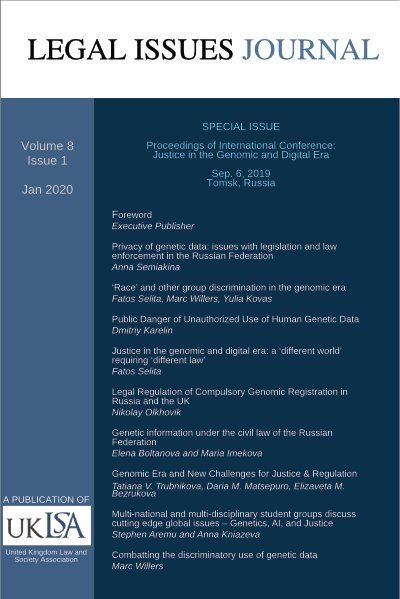
January-June 2020
ISSN 2516-1210 (Print), 2515-9887 (Online)
Leading academics who spoke at the conference “Justice in the Genomic and Digital Era,” an international conference hosted by The Accessible Genetics Consortium (TAGC), explained that gaps exist in existing laws governing the protection of information extracted from sequenced genetic data. These gaps are observed across different continents. For example, in the United States, specific laws such as the Genetic Information Nondiscrimination Act (GINA) 2008, and in Canada, the Genetic Non-Discrimination Act 2017, provide limited protection to individuals. In the European Union, even the most relevant legislation to date, the General Data Protection Regulation (GDPR), provides insufficient protection; for example, one provision may provide protection while another may offer countervailing effects. These limitations arise, among other factors, from the high economic value and commercial interests associated with big data, including data generated from sequenced genetic information, as well as the need for such genetic data for various research purposes in medicine, science, and other fields. As the concluding student session of this intensive conference, students were required to undertake a practical task. Students from law, science, psychology, and linguistics backgrounds were grouped to work collaboratively on diverse topics relating to genetic issues. They were asked to imagine that they were members of the Interdisciplinary Council on the Use of Genetic Information in the Justice System. Their objective was to develop guidelines for policymakers concerning the use of genetic information in the justice system, drawing on the information and insights presented during the earlier conference sessions. In developing their proposals, students were required to consider several issues, including single-gene genotyping versus whole-genome sequencing; single-gene risks versus polygenic risk scores; gene–environment interactions; confidentiality and anonymity; the use of different factors as aggravating and mitigating circumstances in sentencing; genetic literacy and expertise among justice-system stakeholders; and the use of genetic information in the justice system in the era of artificial intelligence, including applications such as robotic judging.
After one hour of intensive discussions, students submitted orally and on paper their proposals which included:
– To establish a global organisation, that would be operated by the UN or similar organisation, for development of regulations for the use of genetic information. This independent body should be multidisciplinary including geneticists, lawyers, policymakers etc., and should have an overarching role to decide when and how genetic data is used and by whom.
– At country level, states should establish departments that will regulate collection and use of genetic information, controlled by international law (which will need to be created).
– Non-profit organisations should be established to represent minority groups, people who do not have access to their own data - to protect these people’s human and civil rights.
– To increase education and awareness for populations as to how their data are being used and so that people can put pressure for appropriate laws and policy.
– Organisations who sequence DNA must have a justifiable reason for it.
– One possibility of prevention unsanctioned use is to limit the use of genomic information to state/non-commercial purposes is to restrict the use of anonymised big data to non-commercial state-run projects.
– Regarding data storage: the risk of de-anonymisation may be reduced if data from individuals were split into multiple sections and stored separately.
– In the criminal justice, in the future, genetic data e.g. polygenic scores, may be used to help with producing individualised probation and rehabilitation plans - to aim to reduce risk of reoffending.
– We need to develop algorithms that would calculate or estimate bias in the existing decisions. For a particular case, if the estimated bias exceeds a given threshold, then the case should be passed on for human judging.
– In light of gene-environment interplay, information on multiple factors (e.g. genes and environment) needs to be considered.
– In education, genetic information that can be used to predict academic achievement should not be used to influence decisions in admissions into educational organisations.
– Potentially genetic information can be used by companies to select employees that are most useful/have most potential for a particular work.
– Genetic information could be used to help inform personalised learning at a school level (i.e. teachers can identify pupils and their propensities for their learning/achievement level), but this would not be shared beyond the school and parents (i.e. should not be shared in official reporting).
– Parents should have the choice regarding whether their children’s genetic data are used to inform their educational direction, but this should be done after parents have received some degree of genetic literacy.
– To begin genetic education early on so that people are familiar with principles from an early age. This will help to de-stigmatise the issue. Genetics should be introduced into the school curriculum from age 12, at an age-appropriate level.
– To include genetics in training and education of legal professional so that they are able to understand the relevant issues in order to reform laws and policy.
– To provide training for juries and judges to raise awareness of interactions between genes and environment, so that they understand the incorrectness of genetic determinism.
This session provided a unique opportunity to work with participants from all around the world, as participating students came from the UK, the Russian Federation, India, Iran, Kazakhstan, and Nigeria. Work in such a culturally diverse team is a unique opportunity to approach a problem from different perspectives, to see it through a completely different experience point. Different professional backgrounds have also made an impact on the result. We were able to combine approaches that consider the legal side of the question, aspects of human development, and top it off with cutting-edge information from the speakers.
It provided a truly unique experience, as it is one thing to discuss societal problems being a part of a privileged group, and the other - to work side by side with students from historically oppressed groups, from countries with different political situations, etc. The genomic era raises questions considering each person on the planet, so there is time to change, and such conferences are a step in the right direction.
Overall, it is time to rise and make a call for the establishment of a regulatory body backed up by strong laws both at the global level as well as the local level (Individual Countries) to oversee the use of sequenced genetic information. The importance of the interdisciplinary nature of such group’s members cannot be overemphasized; a team comprising of geneticists, lawyers, psychologists, medical practitioners, administrators and other professions. It is time for people to be enlightened on information about genetics and how their data are being used. Genetic literacy must cut across specializations, fields, ethnicity and other groupings. There is need for more conferences such as this.
2 Selita, F. (2019). Genetic Data Misuse: Risk to Fundamental Human Rights 2 in Developed Economies. Legal Issues Journal, 7(1), 53–95. DOI: https:// doi.org/10.6084/m9.figshare.11423724
1 Email: annakniazeva74@gmail.com
(2020). Multi-national and multi-disciplinary student groups discuss cutting edge global issues – genetics, AI, and justice. Legal issues Journal, 8 (1), https://www.legalissuesjournal.com/article/08-01-25012020/




