
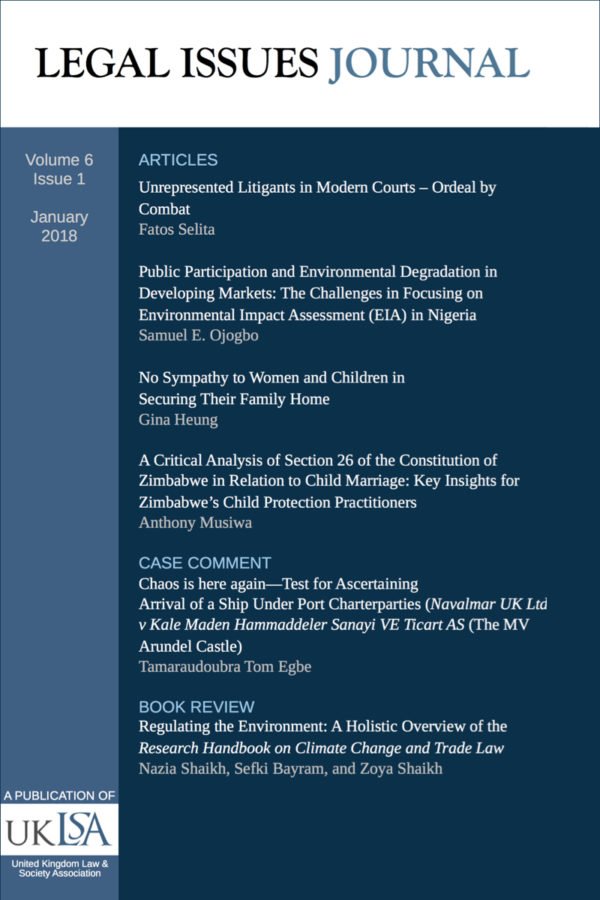
January-June 2018
ISSN 2516-1210 (Print), 2515-9887 (Online)
The debate surrounding climate change has focused on many disciplines, including scientific, economic, and political perspectives. There is a growing discourse that is gaining traction within legal academia, connecting these disciplines to the principles of international law. *The Research Handbook on Climate and Trade Law* identifies the need for stronger environmental laws through existing treaties and organisations and provides a clear outline of how this might be achieved. Climate change must first be understood as negatively affecting the entire world and, secondly, as being caused largely by human activity. The evolution of global environmental changes has had, and will continue to have, potentially catastrophic consequences; this Handbook scrutinises the issue through the lens of law and invites a long-overdue discussion. The Handbook efficiently begins by detailing how human consumption and production have developed through periods of industrialisation, spurred by social greed and the growing demands arising from economic inequality (1). There is an underlying truth with which one must agree in order to understand the premise of the Handbook: the consumption of wealthier nations and the disproportionate ownership of the world’s wealth by an identifiable few have fuelled the changes we see in relation to consumption and production. The beginning chapters of Part I introduce current facts and developments regarding climate change, referencing several agreements and accords. The authors state that the book attempts to fill a gap in the literature on climate law by discussing pressing questions concerning climate change and trade (10). The author claims that these effects need to be addressed for any further discussion to occur (4). Past and present climate change treaties have seemingly fluctuated in their success in addressing both trade and environmental laws and policies. For example, the Kyoto Protocol (5) is heavily discussed and referenced throughout the Handbook. Indeed, this provides an important starting point for international discussions on environmental policy and trade law. The Protocol might be argued to have failed to create a unified solution, while nevertheless succeeding in putting forward the notion that “climate change is a more than delicate issue in which the solution/outcomes will vary depending upon the nation...there’s no homogenous solution as the term climate change itself needs to be reassessed per the status of the nation - developed/developing” (5). Interpretations regarding climate change, which was initially treated as a general topic of discussion, suddenly became a global issue as the international community could not establish a unified definition of the term. Even among developed nations, particularly the United States, a global leader and major power, which was the largest emitter of GHGs during the Obama presidency, there was significant political opposition when the administration proposed a 32% reduction in GHG emissions by 2030; the proposal was rejected by more than half of the US population (1). A government cannot continue with efforts to address climate change if the opposition is in a position of majority.
As stated in the text, this passage identifies that trade law and environmental policies need merely reflect one another. The two are currently on different parallel streams with a divided population and government. However, in 2015 there was a significant accomplishment made and acknowledged by the International community. The Paris Agreement was formulated and praised for its “progressive and positive achievements” (2) and the media took the agreement as a “sign that global leadership was moving in a positive direction with a chance of climate change being actively tackled.” (2) One hundred and ninety-five countries understanding that climate change represents a significant change in international policy, especially trade and environment, approved the agreement.
Two notable repercussions, claimed by the media, to have come out from the agreement had been the importance of identifying “disruptive technologies in energy efficiency,” (6) and the fact that “renewable energy, and sustainable technologies need to be developed.” (3). A new conversation emerged in the discussion of climate change with a strong focus on what sustainable technological initiatives needed to be taken. According to the author, the agreement was a “clear signal given to private actors for practical purposes, commitment to clean energy sources bringing higher private-sector investments.” (3). Although, the reason for the agreement's success was apparently due to its general and universal language.
The Paris Agreement, as further described in detail, was a “voluntary, non-binding instrument whereby countries (retain autonomy and self-determination amongst states) set own national targets for carbon emissions, the agreement doesn’t incorporate a preference for a mechanism to reduce emissions (unlike Kyoto Protocol).” (13). The international community was allowed leeway with this agreement, especially for developing countries who were concerned that they would have to follow strict rulings on emission reduction determined by developed or first world countries. Climate change was no longer an indication of how environmental law needed to be reviewed, but it also brought forward the conversation of what a healthy climate looked like to each nation.
The narrative of environmental discussion gets further layered with a focus on how the environment impacts global markets. The International Court of Justice wants to emphasise the concept of ‘sustainable development’ (31) where, much like a chequebook, any changes to the environment can be met with a positive economy. However, it has claimed to be difficult for policymakers/jurists to achieve/maintain practice of ‘sustainable development.’ An example of this incident was when “India submitted to WTO and CTE (Committee on Trade and Environment) responsibility of importing WTO members - when developing and applying environmental measures – ensure that among other things, they provide due consideration to special development/financial/trade needs of developing country.” (31) India, with other developing nations, would like to see the ICJ recognize the privilege held by developed, first world countries, and request for policymakers to take into consideration shifting and growing economies for countries where markets may not be as steadfast as those of developed countries. Privilege amongst nations is identified by not only their stance on climate change but also how they present their economic policy in regulation such a global concern.
Albeit the author has brought forward the discussion of privilege, policymaking, economies, and self-determination in an attempt to recognize and describe climate change as a global concern, the question remains whether climate change requires government action. Prior to this question, most if not all evidence provided in the handbook focuses on solutions and issues that arise from climate change and trade law discussions. Though, the text seems to answer this question independently, the underlying challenge to tackle climate change remains.
The author breaks down disasters into three categories, “From environmental threats (natural) or human-induced (climate change/loss of biodiversity) to health risks (AIDS/hunger)” (49), and further details issues that prevent international reinforcement. These disasters do not often warrant similar responses from the international community, due to trade rules and the heavy influence of self-determination for States, but as stated in the text governments of course attempt to respond to disaster to a degree. What is key to note in the mention of natural disasters is the impact on trade services and agreements between governments or corporations. The area of impact remains left in disarray, yet the transport of goods and services and procuring of commerce activities remains unperturbed overall. The handbook goes on to state that governments are bound to inaction by treaties and agreements. However, the contributors later contradict this assertion by emphasising the importance of revisiting new standards for trade and climate change to protect human security (77).
This leads to the core discussion of the handbook regarding trade law, climate law, and relevant treaties governing the two areas. There exist many opinions regarding how these two areas co-exist and to a certain extent, are dependent on each other. The World Trade Organisation preamble specifically mentions that the safety and regard of the environment is a key element to the basis of the Organisation. While sustainable development and environmental protection are the words referenced in the preamble, they have been notoriously difficult to define and act upon when it comes to the execution of trade schemes and policies. Rimmer writes in his chapter that trade practices and the health of the open market create a “disharmony between the systems [climate action]” (201).
Noami Klein writes in her book This Changes Everything that “what is most remarkable about these paralleled processes – trade on the one hand, climate on the other – is the extent to which they functioned as two solitudes…actively pretend that the other did not exist, ignoring the most glaring questions about how one would impact the other” (202). This key sentiment is repeated throughout the chapters as various authors look to answer how bodies such as WTO and government actors, private corporations have managed to create a system of laws for trade and the wide prevalence of the force of capitalism have left behind the commitment for sustainable development. The comparisons between specific trade practices, disparities between the North and the South.
The Handbook effectively serves its role as a research reference by focusing, through the later chapters, on regional perspectives on climate change and trade in current challenges from the standpoint of an energy security issue, asking the question of whether the current WTO framework provides for viable and sustainable energy security. To answer this question, it is important to recognise that the WTO is only as strong and effective as the governing nations of which it is comprised (151).
We cannot give substance to the meaning of sustainable development without positive action from State actors and political leaders enforcing it. Another global perspective that the Research Handbook touches upon, indeed an important chapter in this book is Climate law and human rights – new prospects for judicial environmental activism. Should strong jurisprudence and international law gain further traction in this area? There exists a possibility that environmental law can also be litigated heavily and with success just as war crimes under criminal law have been prosecuted.
Our global environment, trade, and climate change are all undoubtedly part of an unhappy partnership, and the demand and desire to capitalize on the Earth’s resources continue unabated. The most significant observable change in this partnership is not necessarily the acknowledgement of this fact, but the apparent inability and unwillingness of individuals and States to act upon this knowledge; alongside the distinct absence of forums and platforms in which such issues could be addressed. However, despite these considerable obstacles, arguably we can now be considered to have entered a period in Human history where advocates, legal and otherwise are gaining invaluable traction in the fight to stay the long and short-term effects of Trade on the Environment.
Regulating the Environment fulfils the need for an approach with greater focus and clarity on the evolving issues, debates and instruments orbiting the issue, providing a tool in the kit of environmental warriors and conscientious capitalists alike. One criticism advanced may be to highlight the anthropocentric approach that often comes through in much of the book. However, this can also be interpreted as being entirely consistent with the prevailing approach of environmental protection, which is the protection of humankind above all else. In conclusion, this book has a well-deserved and happy place in the knapsacks of budding Environmental lawyers and academics, but more importantly perhaps, the shelves of corporations under pressure to comply with improving global standards.
(2018). Regulating the Environment: A Holistic Overview of the Research Handbook on Climate Change and Trade Law. Legal issues Journal, 6 (1), https://www.legalissuesjournal.com/article/06-01-11012018/




